How to Import Bulk Matcha from China: A Step-by-Step B2B Sourcing & Customs Guide
A comprehensive step-by-step B2B guide to importing bulk matcha powder from China, covering supplier verification, required customs documents, regulatory compliance, and shipping logistics.
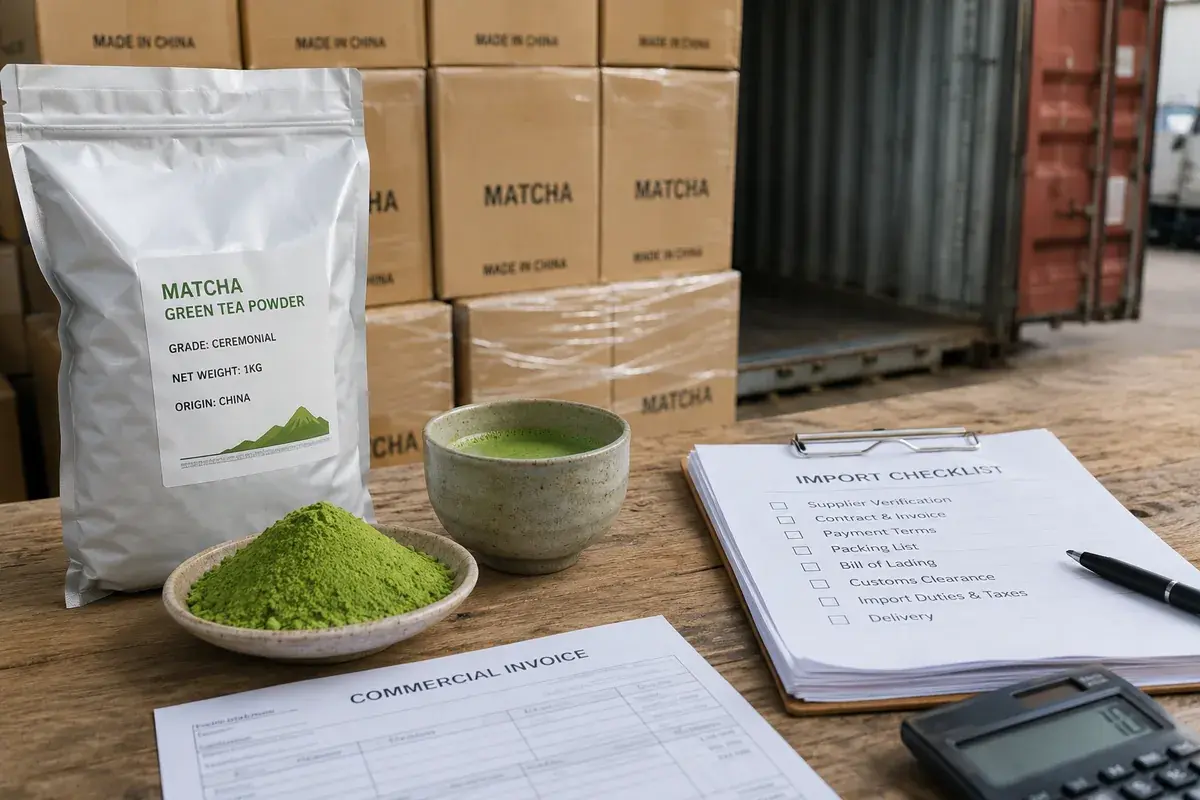
Table of Contents
Need Samples for R&D or Formulation?
We provide free samples of Ceremonial, Premium, and Culinary grade matcha for commercial testing.
For global beverage chains, food manufacturers, and wellness brands, sourcing bulk matcha powder directly from China offers a massive commercial advantage. By bypassing intermediaries and working directly with a vertically integrated manufacturer, brands can optimize their Cost of Goods Sold (COGS) by 30% to 50% while securing a scalable, year-round supply. (Compare origins in our Chinese vs. Japanese Matcha Sourcing Guide.) However, importing food products across international borders involves strict regulatory compliance, customs clearance, and logistics coordination. Sourcing the wrong way can lead to customs delays, fines, or rejected shipments. This step-by-step B2B guide outlines the entire process of importing bulk matcha from China, ensuring a smooth, compliant, and cost-effective supply chain.
Step 1: Supplier Verification and Quality Evaluation
The foundation of a successful import starts with choosing the right manufacturing partner. Unlike buying finished retail goods, bulk food ingredients require strict quality control at the source. B2B buyers should verify the following:
- Facility Certifications: Ensure the factory is registered with the US FDA (for US imports) and holds international food safety certifications such as ISO22000, HACCP, or FSSC22000.
- Request a Certificate of Analysis (COA): Every batch of matcha must be accompanied by a COA detailing physical parameters (moisture < 5.0%, ash < 7.0%, particle size D90 < 10μm) and microbiological limits. (Learn how to read these metrics in our Matcha Quality Grading & Evaluation Standards.)
- Pesticide and Heavy Metal Testing: Request third-party lab reports (SGS or Eurofins) showing compliance with the Maximum Residue Limits (MRLs) of your importing country. This is especially critical for the EU market, which has extremely strict pesticide thresholds.
Step 2: Understanding Import Regulations and Compliance
Before shipping, you must ensure that your product complies with the food authority regulations of your destination country:
United States (FDA & CBP)
- FDA Facility Registration: The Chinese manufacturer must have a valid FDA registration number.
- Prior Notice: A Prior Notice (PN) must be filed electronically with the FDA before the food shipment arrives at the port of entry. Your customs broker can handle this.
European Union (EFSA)
- Strict MRL Compliance: The EU enforces zero-tolerance or extremely low limits for many common agricultural pesticides. Ensure your supplier provides EU-compliant test reports.
- Organic Imports: If importing organic matcha, the shipment must be accompanied by a Certificate of Inspection (COI) issued via the EU's TRACES system, linked to a valid organic Transaction Certificate (TC). (See our Private Label & OEM Sourcing Guide for organic compliance details.)
Step 3: Essential Customs Documentation Checklist
Having the correct paperwork is the single most important factor in preventing customs delays. When importing bulk matcha from China, the exporter must provide the following documents:
- Commercial Invoice: Detailing the buyer, seller, product description, quantity, unit price, and total value.
- Packing List: Specifying the net and gross weight, number of cartons, and packaging dimensions.
- Bill of Lading (B/L) or Air Waybill (AWB): The contract of carriage between the shipper and the carrier.
- Phytosanitary Certificate: Issued by the China Customs (CIQ), certifying that the tea leaves have been inspected and are free from quarantine pests. This is a mandatory document for agricultural imports in almost all countries.
- Certificate of Origin (C/O): Proves the goods were manufactured in China. In some countries with bilateral trade agreements, this can reduce import tariffs.
- Certificate of Analysis (COA): Verifying the quality and safety parameters of the specific batch.
Step 4: Choosing the Right Shipping Method
The choice of logistics depends on your order volume, budget, and the grade of matcha being imported:
- Express Courier (DHL/FedEx/UPS): Best for small trial orders or samples (under 100kg). It is fast (3-7 days) and includes customs clearance support, but the cost per kilogram is high.
- Air Freight: Ideal for medium-sized shipments (100kg to 500kg) of high-value grades like Ceremonial Grade Matcha. It takes 5-10 days and prevents long exposure to high temperatures during transit.
- Sea Freight (LCL or FCL): The most cost-effective method for large bulk orders (over 500kg).
Important Quality Tip: Matcha is highly sensitive to heat, which degrades chlorophyll and turns the powder brown. (Read about this in The Matcha Production Process.) During hot summer months, it is highly recommended to ship bulk matcha in Reefer Containers (temperature-controlled containers) maintained at 2°C to 8°C to preserve color and freshness during the ocean voyage.
Step 5: Customs Clearance and Tariffs
When the shipment arrives at the destination port, it must undergo customs clearance:
- HS Code Classification: Matcha is classified under the Harmonized System (HS) code for green tea. The standard international code is 0902.10.90 (Green tea, unfermented, in immediate packings of a content not exceeding 3 kg) or 0902.20.90 (Other green tea, unfermented, in packings exceeding 3 kg). Ensure your customs broker uses the correct code to determine the tariff rate.
- Hire a Customs Broker: Unless you have an in-house logistics department, hire a licensed customs broker in your country. They will file the entry, pay the duties and taxes, and coordinate with food safety inspectors on your behalf.
Summary: The Import Process Timeline
| Phase | Key Actions | Estimated Time |
|---|---|---|
| 1. Pre-Order | Evaluate samples, verify COA and pesticide reports, confirm compliance with local regulations. | 1 - 2 Weeks |
| 2. Production | Factory grinds the Tencha, packs the powder under nitrogen-flushed conditions, and issues the batch COA. | 2 - 3 Weeks |
| 3. Export & Transit | CIQ issues the Phytosanitary Certificate. Goods are shipped via air (5-10 days) or sea (20-40 days). | Varies by method |
| 4. Customs Entry | Customs broker files Prior Notice (US) or TRACES (EU), pays duties, and clears the goods through customs. | 3 - 7 Days |
Partner with Orisen Tea for Hassle-Free Exporting
Hunan Orisen Biotech Co., Ltd. (Orisen Tea) is a vertically integrated manufacturer and experienced exporter of bulk matcha powder. We manage our own shade-grown tea gardens and certified processing facilities, allowing us to control quality from soil to shipment. We offer a full range of grades, including Ceremonial Grade Matcha, Premium Grade Matcha, and Culinary Grade Matcha. We handle all export documentation, including Phytosanitary Certificates, COAs, and Organic TCs, and work with top-tier logistics partners to offer FOB, CIF, and DDP shipping options worldwide. Contact our export sales team today to request free samples and discuss your import requirements.
FAQ: Importing Bulk Matcha
Q1: Can I import organic certified matcha from China?
Yes. Orisen Tea offers USDA Organic and EU Organic certified matcha. We provide the necessary Transaction Certificates (TCs) and COIs to ensure your organic status is fully recognized by customs and organic certifiers in your country.
Q2: What is the minimum order quantity (MOQ) for importing bulk matcha?
Our bulk wholesale MOQ starts at 100kg for standard grades like Premium Grade or Culinary Grade. For custom blending or private label packaging, the MOQ varies depending on the packaging type. (Read more in our Private Label & OEM Sourcing Guide.)
Q3: How do you protect the matcha from heat during sea transit?
For sea shipments during warm seasons, we recommend and arrange temperature-controlled Reefer Containers. We also pack our bulk matcha in multi-layer aluminum foil bags flushed with nitrogen to prevent heat and oxygen from degrading the chlorophyll.
Interested in Sourcing Premium Matcha Powder?
Hunan Orisen Biotech Co., Ltd. is a certified factory source. Contact us for bulk wholesale pricing, custom formulation, or OEM private label packaging.